
Blog
The Ceiling Is the Next Network Layer, And X-PoE Is How You Build It
The Ceiling Is the Next Network Layer, And XPoE Is How You Build It (Revised) Every modern building has two parallel infrastructures running through it: the electrical...
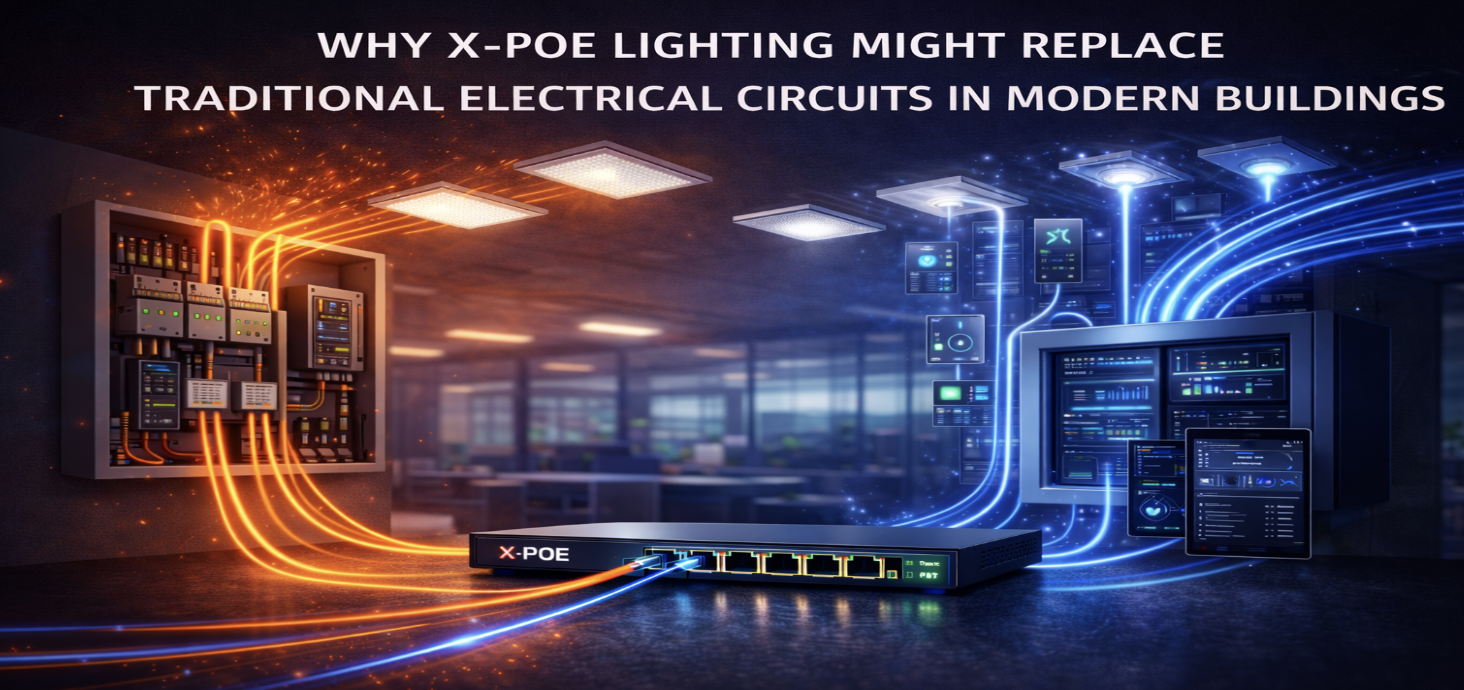
The Ceiling Is the Next Network Layer, And X-PoE Is How You Build It (Revised)
Every modern building has two parallel infrastructures running through it: the electrical system and the IT network. One delivers power. The other delivers data. They were designed separately, installed by different trades, and managed by different teams.
That separation made sense for decades. It doesn't anymore.
The ceiling — where lighting fixtures, sensors, and access points live — is becoming the most important data surface in a building. But it's still served by 1960s-era electrical circuits that can't report, can't adapt, and can't participate in the building's intelligence layer. X-PoE changes that by converging power, control, and data onto a single structured cabling infrastructure — turning every ceiling fixture into a networked, addressable endpoint.
This isn't a lighting upgrade. It's an infrastructure convergence.
1. Two Infrastructures Where There Should Be One
In a traditional building, lighting runs on AC branch circuits — conduit, breakers, standalone LED drivers, and separate 0–10V or DALI control wiring. Meanwhile, the IT network runs structured cabling to cameras, access points, and sensors. These two systems overlap physically (they both terminate in the ceiling) but share nothing architecturally.
The result: two parallel cable plants, two installation trades, two maintenance workflows, and zero shared intelligence between them.
X-PoE collapses this into a single layer. Each X-PoE port delivers power and data over standard Cat5e/Cat6 cabling. The XS-108H switch provides 8 auto-sensing ports — each with two individually controllable channels, constant current dimming down to 1%, and per-channel power metering at over 95% accuracy. And because every port is backward-compatible with IEEE 802.3af/at/bt (up to 90W per port), the same switch that drives your lighting can power standard PoE devices like sensors, cameras, and wireless access points.
One cable plant. One infrastructure team. One management layer.
2. Every Ceiling Device Gets an Identity
Traditional electrical circuits are anonymous. A breaker powers a group of fixtures, and the building has no idea which individual fixture is on, off, drawing power, or failing. Sensors and cameras on the IT side have identities — IP addresses, MAC addresses, health status — but the lighting system next to them is a black hole.
X-PoE brings IT-grade device identity to every fixture. The switch auto-detects whether a connected load is an IEEE PoE device, a standard X-PoE load, or a custom load — and configures power delivery accordingly. Each channel is individually monitored: the system knows what's connected, what load type it is, and exactly how much power it's drawing in real time. If a fixture is swapped, the port retains its configuration — load type, power profile, zone assignment — without re-mapping.
This is the same level of device awareness that IT teams expect from network switches. X-PoE extends it to every light in the ceiling.
3. The Ceiling Becomes a Distributed Sensing Platform
Lighting fixtures occupy the most valuable real estate in a building: evenly distributed across the ceiling with line-of-sight to the occupied space below. That makes them ideal hosts for sensors — occupancy, daylight, environmental, motion.
In traditional buildings, deploying a sensor network means running a separate infrastructure: dedicated wiring, standalone gateways, and a parallel management platform. With X-PoE, the lighting infrastructure is the sensor backbone. The system is controls-agnostic — it integrates with any IP-based controls system via REST API and MQTT, and standard IEEE PoE PDs can power a variety of low-voltage sensors, switches, and controllers directly from the X-PoE switch.
Instead of asking "where do we put the sensors?" the question becomes "what sensors do we add to the lighting infrastructure that's already there?"
The ceiling stops being passive real estate and starts answering questions:
- Which areas are actually occupied?
- Where is energy being wasted?
- How do usage patterns shift throughout the day and week?
4. Zones Are Software, Not Wiring
In traditional systems, a "zone" is a physical circuit. An electrician wires a group of fixtures to a switch, and that wiring defines the zone for the life of the building — or until someone
continue
pays to rewire it. Teams move, rooms change purpose, hybrid work reshapes occupancy. The lighting zones stay frozen in place.
X-PoE decouples zones from wiring entirely. Because there are no hardwired control circuits — no 0–10V loops, no DALI buses, no dedicated relay panels — every fixture is independently addressable at the port level. Zone assignments live in software. Reassigning a fixture from one zone to another happens in the Luum app: no rewiring, no electrician, no ceiling access.
IT teams already think this way. VLANs don't require re-cabling the switch closet. Wi-Fi zones don't require moving access points. X-PoE brings that same logic to lighting: the physical layer stays fixed while the logical layer adapts.
A floor gets reorganized on Monday. Lighting zones match by Tuesday. Not six months later when the capital request for rewiring gets approved.
5. The LED Driver Moves From the Ceiling to the Closet
This is the architectural shift that makes everything else possible.
In traditional lighting, every fixture contains its own LED driver — the component that converts AC power to the regulated DC current the LEDs need. Drivers are the most failure-prone component in a fixture. They run hot, they degrade, and when they fail, someone needs a lift, ceiling access, and a replacement unit. That maintenance burden is expensive and slow, so it gets deferred. Fixtures sit dark or stuck at full power, and operators override automation rules to compensate.
X-PoE centralizes the driver function inside the switch. The XS-108H contains the LED driving circuitry — constant current and constant voltage regulation — and delivers precisely controlled power over Cat5e/Cat6 to driverless fixtures through simple PD adapters. The fixture itself becomes a passive LED light engine with no active electronics to fail.
The result:
- Fixture life expectancy increases by around 4x — the component most likely to fail has been removed from the harsh above-ceiling environment
- Maintenance happens at rack height in the electrical closet, not on a lift in the ceiling
- Zero standby power — when a port is off, it draws nothing
- Per-channel power metering means the system detects anomalies (a fixture drawing unexpected current, a channel that won't dim) before an operator ever notices a problem
This is the same principle that drove the shift from distributed servers under every desk to centralized server rooms. Move the intelligence and the failure-prone components to a place where they're accessible, monitorable, and maintainable.
6. Building Operations Shift From Reactive to Continuous
Traditional lighting systems are invisible to operators. They consume power, but there's no telemetry. You find out something is wrong when a tenant complains or an energy bill spikes. By then, the waste has been accumulating for weeks or months.
When every fixture is a networked endpoint, the building generates continuous operational data. The Luum platform sits on top of this telemetry layer and turns it into actionable intelligence:
- Real-time dashboards show what's running, at what power, across every zone
- AI-powered anomaly detection flags drift — a schedule that stopped executing, a zone drawing more power than expected, a fixture behaving differently from its neighbors
- Persistent site memory tracks findings and recommendations over time, so investigations don't start from scratch every time someone looks at the data
- Historical baselines let operators compare current performance against commissioning benchmarks or any prior period
The building doesn't just run. It reports on how it's running — continuously, automatically, and at the individual fixture level.
7. IT and Facilities Finally Speak the Same Language
Here's the organizational shift that doesn't get enough attention.
Traditional lighting lives in the facilities world: electricians install it, building engineers maintain it, and the IT team has no visibility or involvement. But when lighting runs on structured cabling, connects to the IP network, and is managed through software — it starts looking a lot like IT infrastructure.
X-PoE accelerates this convergence:
- Installation uses structured cabling — the same Cat5e/Cat6 that IT teams already spec, install, and manage
- Switches live on the IP network — with DHCP, static IP support, REST API, and MQTT interfaces
- Low-voltage installation means cabling can be done by low-voltage contractors rather than licensed electricians, aligning with how IT infrastructure is typically deployed
- Cloud connectivity through the AMBR (Amatis Border Router) bridges the on-premise lighting network to the Luum platform for remote monitoring and management
Instead of electrical and IT systems operating as parallel silos, infrastructure begins to converge. The lighting system becomes something the IT team can see, manage, and integrate with — just like every other networked system in the building.
TL;DR
The ceiling is becoming the most important data surface in modern buildings. X-PoE + Luum treat it that way:
| Old Model | X-PoE Model |
|---|---|
| Two parallel infrastructures (electrical + IT) | One converged cable plant: power, data, and control on Cat5e/Cat6 |
| Anonymous fixtures on blind circuits | Every port is auto-detected, individually monitored, and uniquely addressable |
| Separate sensor networks bolted on after the fact | Lighting infrastructure doubles as the sensor backbone via IEEE PoE |
| Hardwired zones that outlive every floor plan | Software-defined zones reconfigured in the app |
| Distributed drivers failing in the ceiling | Centralized drivers in the closet; driverless fixtures with around 4x longer life |
This isn't a lighting upgrade. It's the convergence of electrical and IT infrastructure at the ceiling — where the building meets the people inside it.